How Does Robotics and Coding Support Children's Math Skills?
Getting a robot to travel exactly 20 centimetres, changing the speed of a mechanism or programming a different response based on sensor data may feel like an exciting robotics challenge to a child. At the same time, however, the child is working with distance, numbers, sequences, measurement, patterns, direction, proportion and problem solving. This is one of the most valuable aspects of robotics and coding for children. Mathematics stops being something that only happens on paper and becomes something children can build, observe, test and change. So how can robotics and coding support children's mathematical thinking?
What Is the Connection Between Robotics, Coding and Mathematics?
Coding requires children to break a problem into smaller steps and arrange those steps in a logical order. Imagine that a child wants a robot to move from one point to another. They may need to consider: - How far should it travel? - Which direction should it turn? - How long should the motor run? - What speed should it use? - How many times should an action repeat? - Which value should change if the first solution does not work? Each question involves a different form of mathematical thinking. The child does not only calculate an answer. They can see the physical result of their decisions. That connection between a number and a real-world outcome can make abstract ideas much easier to understand.
1. Numbers Become Meaningful
For young children, understanding mathematics involves more than recognising number symbols. They also need opportunities to experience what numbers represent. In robotics, numbers have a purpose. “Run the motor for 3 seconds.” “Change the speed to 50.” “Repeat the action 4 times.” “Turn the robot 90 degrees.” The numbers 3, 4, 50 and 90 now create visible changes in a real system. This can help children connect abstract numerical values with concrete outcomes.
2. Children Discover Patterns and Sequences
Pattern recognition is an important part of mathematical thinking. It is also fundamental to coding. A robot might follow a sequence such as: move forward → turn on a light → play a sound → move backwards Children can then explore what happens when the sequence repeats. Could the movement repeat three times? Could the light change every second repetition? Could a loop replace several repeated instructions? Through these challenges, children begin to recognise structure and repetition rather than seeing every instruction as an isolated step.
3. Problem Solving Becomes Part of Mathematics
Robotics projects do not always work on the first attempt. A robot might stop too early. It may turn too far. A sensor may not respond in the way the child expected. A mechanism may lose its balance. Instead of simply receiving the correct answer, the child needs to investigate. Where is the problem? Which value should I change? What happens if I change only one variable? How can I make the solution more accurate? This process closely resembles mathematical problem solving. Children analyse the situation, develop a possible solution, test it and refine their thinking.
4. Measurement, Distance and Geometry Become Visible
Imagine a robot moving through a course. The child needs to think about more than simply making it move. They may need to consider: How far should it travel? What angle should it turn? What is the distance between two points? Does wheel size change how far the robot travels? Why is the model losing balance? What happens if a component moves to another position? Distance, angle, position, direction and spatial reasoning become part of a real design problem. With hands-on systems such as LEGO® Education, children can immediately see the effect of changing their model or their code.
5. Children Learn to Predict and Test
One of the most useful questions in a robotics workshop is: “What do you think will happen?” For example: What happens if we increase the motor speed from 30 to 60? What happens if we add more weight to the robot? Will a larger wheel travel farther in the same amount of time? The child first makes a prediction. Then they test it. They observe the result. They compare the result with their prediction. Then they adjust their idea if necessary. This creates a valuable cycle: prediction → experiment → observation → comparison → new solution That process is central to both mathematical and scientific thinking.
6. Coding Develops Algorithmic Thinking
An algorithm is simply a clear sequence of steps used to reach a goal. Children use this type of thinking naturally. If a robot needs to pick up an object and carry it somewhere else, the child might plan: 1. Move forward. 2. Detect the object. 3. Stop. 4. Activate the mechanism. 5. Move back. 6. Release the object. The important learning is not only the code. The child has broken a larger problem into smaller steps and organised them logically. This step-by-step thinking is also useful when solving mathematical problems.
7. Mistakes Become Part of the Learning Process
Some children become anxious about giving the wrong answer in mathematics. Robotics offers a different relationship with mistakes. If a robot does not turn correctly, the project has not failed. Something needs to be changed. The child can test another value. Modify the code. Adjust the design. Try again. This creates an environment where children focus on developing a solution rather than simply finding one correct answer immediately.
Does Robotics Replace Mathematics Lessons?
No. Robotics and coding are not substitutes for mathematics education. Their strength is that they give children a place to apply mathematical ideas inside meaningful projects. A child building a robot may not think: “I am doing mathematics.” Yet they may be: - using numbers - comparing distances - identifying patterns - exploring angles - interpreting information - making predictions - solving problems - improving solutions Mathematics becomes a tool for creating something.
How Does Robotics and Mathematics Change With Age?
Robotics activities should change according to a child's age, experience and developmental level.
Ages 3–4
At this stage, the focus is not advanced coding. Children can explore: - sequencing - colours - directions - simple patterns - cause and effect - part-whole relationships through playful physical activities.
Ages 5–7
Children can begin using block-based coding and observe how numerical values affect what their models do. Projects may naturally include: - motor speed - duration - repetitions - direction - sensor values - simple measurement - comparison
Ages 8 and Up
As children gain experience, projects can involve more complex ideas such as: - variables - conditions - loops - sensor data - ratios - optimisation - engineering challenges This is why the right robotics programme should consider more than a child's age alone. Experience, curiosity and readiness also matter.
How Does Code of Bricks Use Mathematics in Robotics Projects?
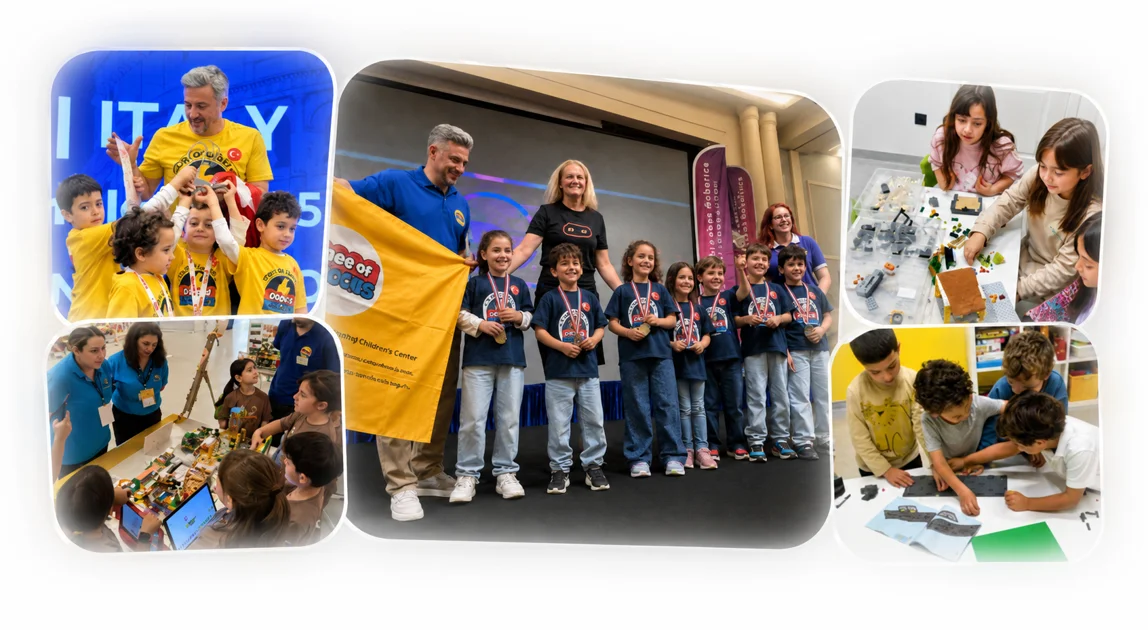
At Code of Bricks, mathematics is not added to robotics projects as a separate worksheet. It appears naturally inside the challenge. Children use numbers when adjusting motor speed. They work with distance and direction when programming movement. They use geometry when designing mechanisms. They compare sensor readings. They use sequencing and algorithms when coding. Throughout the process they: explore → design → build → code → test → improve At our discovery centre in Göktürk, Istanbul, children work on age-appropriate robotics, coding and creative technology projects that make these ideas tangible.
How Do I Know Where My Child Should Start?
Every child has a different relationship with technology and mathematics. One child may immediately enjoy mechanical design. Another may be fascinated by coding. Another may enjoy repeating an experiment until the result is exactly right. That is why we do not choose a programme based only on age. During an individual introductory workshop, we can observe your child's interests, experience and readiness and help identify an appropriate starting point.
Frequently Asked Questions
Can robotics help children with mathematics?
Robotics is not a replacement for mathematics lessons, but it gives children opportunities to apply concepts such as numbers, measurement, patterns, direction, geometry, sequencing and problem solving in hands-on projects.
Why is coding connected to mathematics?
Coding involves logical sequences, patterns, values, conditions and problem solving. Children often use mathematical thinking when deciding how a program should behave and when adjusting their code.
Can a child who does not enjoy maths enjoy robotics?
Yes. In robotics, mathematical concepts often appear as part of a practical challenge rather than as a traditional calculation exercise. This can give children a different way to engage with numbers and problem solving.
At what age can children start robotics and coding?
Age-appropriate robotics activities can begin in early childhood. Younger children explore sequencing, cause and effect and simple mechanisms, while older children gradually work with coding, sensors, data and more complex engineering challenges.
Where can children attend robotics and coding workshops in Istanbul?
Code of Bricks offers in-person robotics, coding and creative technology workshops for children at its discovery centre in Göktürk, Istanbul. Programmes are selected according to the child's age, experience and readiness.
Discover the Right Starting Point for Your Child
During an individual introductory workshop, we can observe your child's interests, experience and readiness and help identify an appropriate starting point.
Request a Free Introductory Workshop